Introduction
My name is Anya Lundstrom, I am a recently graduated MA TESOL student from the University of Arizona. I have two bachelors in East Asian Studies with an emphasis on the Japanese Language and English Creative writing as well as two associates in Astronomy and Norwegian. I speak three languages with English being my first language. I learned Japanese and Norwegian at the same time and consider myself conversational in both languages. I learned Japanese due to my interest in the Japanese culture and have found myself wanting to explore additional Asian languages like Korean or Chinese. I learned Norwegian because my family heritage is Norwegian, but sadly the language has been lost to my family over the generations. Outside of academics, I am a business owner of two separate businesses with one being retail for gymnastics leotards and the other being my art. I have a degree in creative writing and love story telling because of this I am also currently writing a couple of novels, with one novel complete and in the editing process.
What I Hope You Will Take Away from This Portfolio
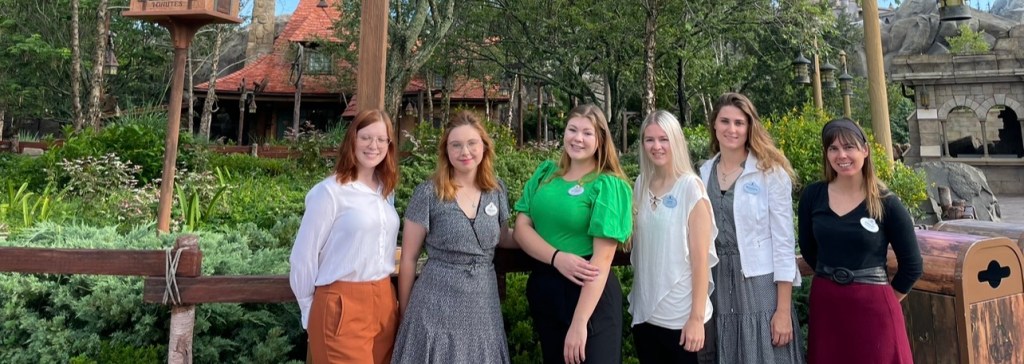
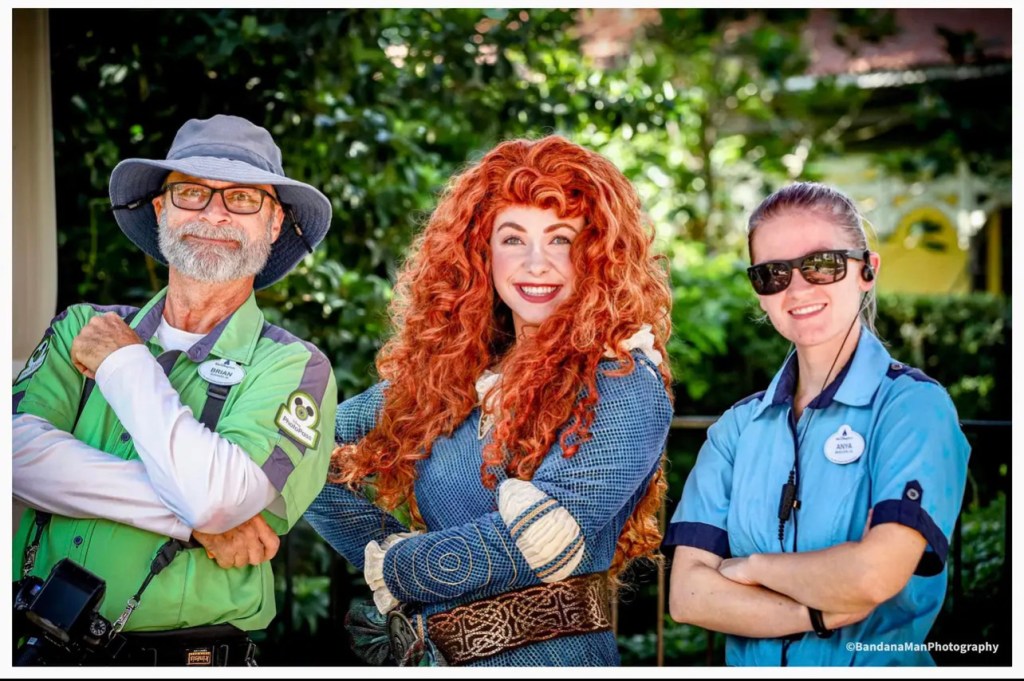
I hope that this Portfolio will show you who I am as a person, who I am as a professional, and what skills and insights I can bring to the work place. This portfolio is designed to show you my academic career through my CV and resume, my academic works through my lesson plan examples and my capstone project, and my personal philosophy when it comes to language learning. I hope that the images found throughout this portfolio; although mostly non-academic; will show you who I am on a more personal level. These photos showcase not only my passions for the Asian culture, specifically Japan, but also my passion and love for Disney and the sport gymnastics. These characteristics make me up as a person both personally and professionally, I personally believe that who you are as a person is reflected in your professional life. I hope that these two uniquely different perspectives of me showcase you what I as a person can bring to a work place.
What’s Important To Me on a Professional Level
On a Professional level I believe that courtesy, holding oneself accountable, kindness, and open mindedness are important. To show courtesy and kindness to both your co-workers and to your customers/students are of great importance to me. It not only shows that you care about them, but that you are also listening to them, taking in what they are saying and in some cases acting on what they have requested. I believe the more courtesy and kindness you show, the more encouraging the workplace becomes. I also believe that it is important to hold oneself accountable for their actions. If I or someone else does something wrong, I believe in owning up for you actions rather than blaming others. It is important because it shows how sincere you are as a person and how you as a person are. If you blame others, the trust is easily broken, but if you own up for your actions it shows you have great character. I also believe that it is important to be open minded. People around you may not have the same view point as you on different topics, but that doesn’t mean you should dismiss them or throw their view points away. Instead I believe it is important to see things from their side while also letting them know that if you disagree with their opinions, you still value and will try to understand their opinions or views on a topic.
What’s Important To Me on a Personal Level
On a personal level I believe that actions, learning and discovery are important. When it comes to actions, I firmly believe that actions speak louder than words, though in some cases I do believe that speaking and actions should go hand in hand. In regards to learning, I have had multiple instances where I have doubted myself over my thirst to continue learning either academically or personally. I often believed that learning at an older age was often seen as me not following the right path, but I have also had multiple chances to talk to people who have encouraged me to continue on my learning path. As they said “Never stop learning” and I have taken that to heart. I believe it is important to never stop learning, to always see what could be learned and how those skills or knowledge I gained could benefit me and the world and how it can open my eyes and mind to things I had never seen, heard or even thought of before. Lastly I believe it is important to discover new things. Being comfortable is nice, but discovering something new or something you have to do to learn new things about the world. That’s why I firmly believe that going out of your comfort zone and discovering new food, places, skills, knowledge, people, and hobbies is something that should be done.
Open Novel: A Translation Tool for Chinese, Japanese, and Korean Novels
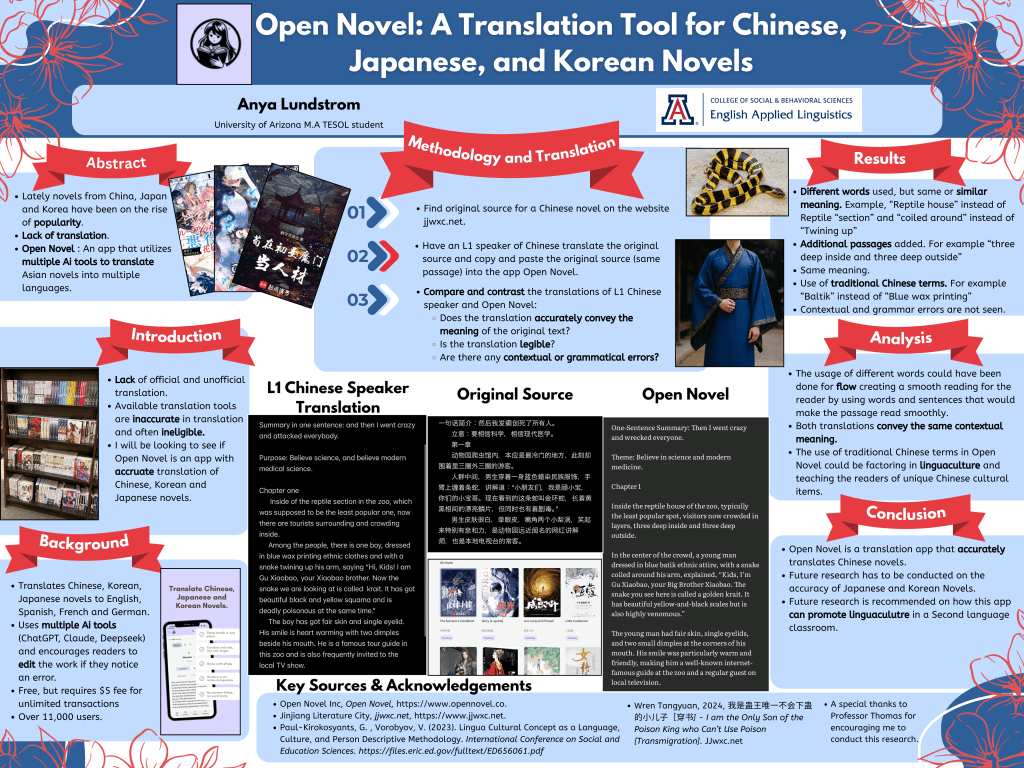
My capstone project was conducted during my last semester as a MA TESOL student at The University of Arizona. The focus of this capstone was on the accuracy of the translation tool Open Novel, focusing specifically on Chinese translation for this project.
The hope of this project was to connect to people and help them realize why they learned a second language and how tools like Open Novel can promote and encourage learners of all age to learn a new language and culture.
In order to determine the accuracy of the translation of Open Novel, I chose a Chinese novel I had been reading and took a passage from that novel and had both Open Novel and a L1 speaker of Chinese translate it. From there I looked at if the Open Novel translation accurately conveyed the meaning of the original text, if the translation was legible, and if there were any contextual or grammatical errors.
In my analysis I noticed that Open Novel chose to alter some words to promote flow from paragraph to paragraph as well as keep the original Chinese words for cultural terms, For example the word Baltik. There were also some grammatical differences when it came to word use, like “older brother” being used in the Open Novel translation. One thing that has been pointed out is that the Open Novel translation kept certain Chinese idioms while the L1 speaker chose to remove these idioms when translating to Chinese. This left me wondering if I were to show the Open Novel translation to the Chinese L1 speaker, if the translation would have then changed.
 Anya's Teaching Portfolio